The eIOU Wallet enables seamless value transfer through a network of
trusted connections. Each user can create their own digital tokens (like
"Alice-USD") that represent their creditworthiness. When you connect with
someone, you decide how much of their tokens you're willing to hold,
creating a web of trust that enables instant transfers.
Direct Transfer
Alice wants to send Bob $100 in Alice-USD tokens
Alice creates and sends her own Alice-USD tokens to Bob.
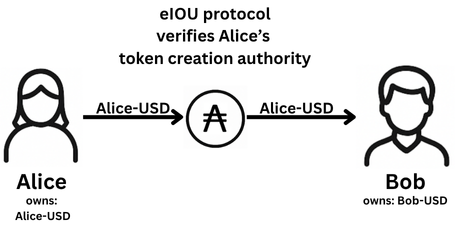
- Alice initiates a transfer of $100 Alice-USD tokens to Bob
- The eIOU Protocol verifies Alice's token creation authority
- Bob receives $100 worth of Alice-USD tokens instantly
- Transaction is saved by both users privately
Alice wants to send Bob $100 in Bob-USD tokens
Alice has $100 worth of Bob-USD tokens in her available credit.
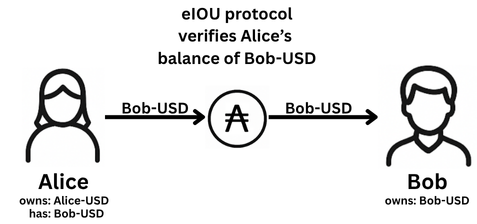
- Alice initiates a transfer of $100 Bob-USD tokens to Bob
- The eIOU Protocol verifies Alice's balance
- Bob receives $100 worth of his tokens instantly
- Transaction is saved by both users privately
Multi-hop Transfer
Alice wants to send Carol $100 via Bob using their respective tokens
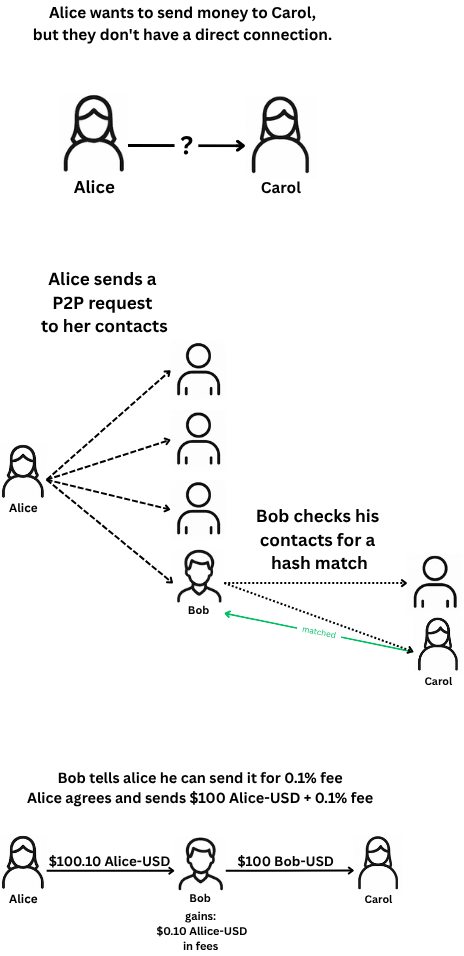
Alice wants to send money to Carol, but they don't have a direct
connection. Bob, who has credit with both Alice and Carol, acts as an
intermediary. Bob can charge a small fee for taking on the risk of
routing the transfer.
-
Alice sends a Peer to Peer request searching for someone who can
send $100 USD to Carol
-
Bob calculates the hash for each of his contacts, checking if any
match the hash Alice sent
-
Bob finds a match, and informs Alice he can send it for a 0.1% fee
- Alice initiates a transfer of $100.10 Alice-USD tokens to Bob
- Bob receives $100.10 worth of Alice-USD tokens
- (If Alice has $100.10 Bob-USD she could use that too)
- Bob then sends $100 Bob-USD tokens to Carol
- Carol receives $100 worth of Bob-USD tokens
- All transactions are saved privately by each participant
Complex Network Transfer
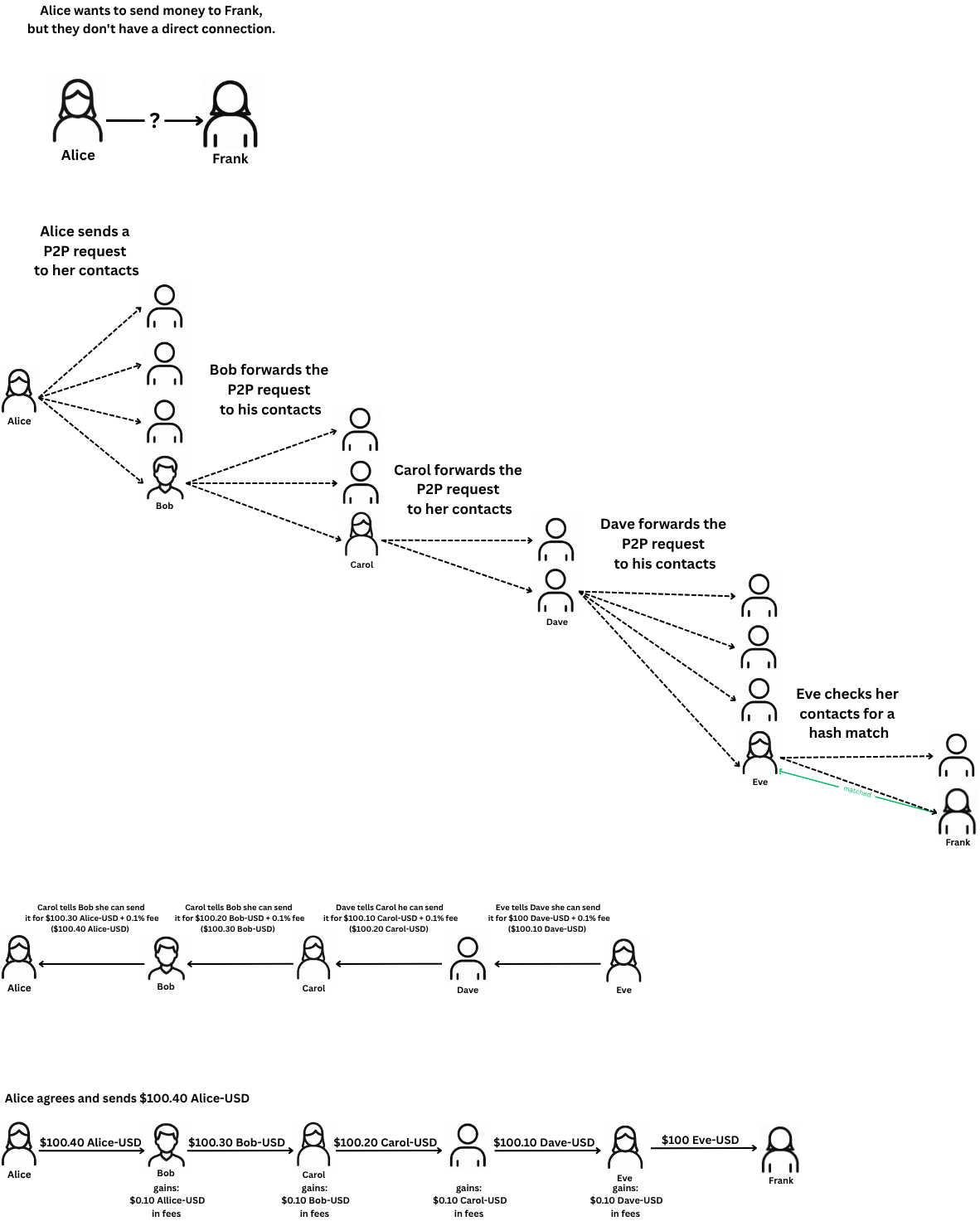
Alice wants to send money to Frank through multiple intermediaries
(Bob, Carol, Dave, Eve). Each intermediary can charge a small fee for
routing the transfer and taking on risk.
-
Alice wants to send $100 USD to Frank, but he is not a contact of
hers
-
Alice sends a Peer to Peer request searching for someone who can
send $100 USD to Frank
-
Alice hashes the her request (e.g. send $100 USD to Frank), along
with the time, and a salt
-
Bob calculates the hash for each of his contacts, checking if any
match the hash Alice sent
- Bob does not find a match, and forwards it to his contacts
- Carol does not find a match, and forwards it to her contacts
-
Dave does not find a match either, and forwards it to his contacts
-
Eve finds a match, checks her credit with Frank, and informs Dave he
can send it for a 0.1% fee, $100.10 Dave-USD
-
Each peer adds their desired fee, for simplicy we'll say it's 0.1%
for all of them. Dave asks for $100.20 Carol-USD, Carol asks for
$100.30 Bob-USD, and Bob asks for $100.40 Bob-USD
-
Through collaboration, Alice's peers find a route: Alice → Bob →
Carol → Dave → Eve → Frank
-
Alice accepts the fee, and sends it on to Bob, Bob to Carol, etc
-
Each node in the path automatically forwards the payment, taking on
the risk with the previous sender
- Frank receives the $100 Eve-USD
-
Debts are created along the chain: Alice owes Bob, Bob owes Carol,
etc.
Trust-based Transfer
Alice wants to send Bob $100 in Bob-USD tokens but needs credit
Alice wants to send money to Bob but doesn't have sufficient Bob-USD
tokens. Her friend Carla provides trust by accepting Alice-USD tokens.
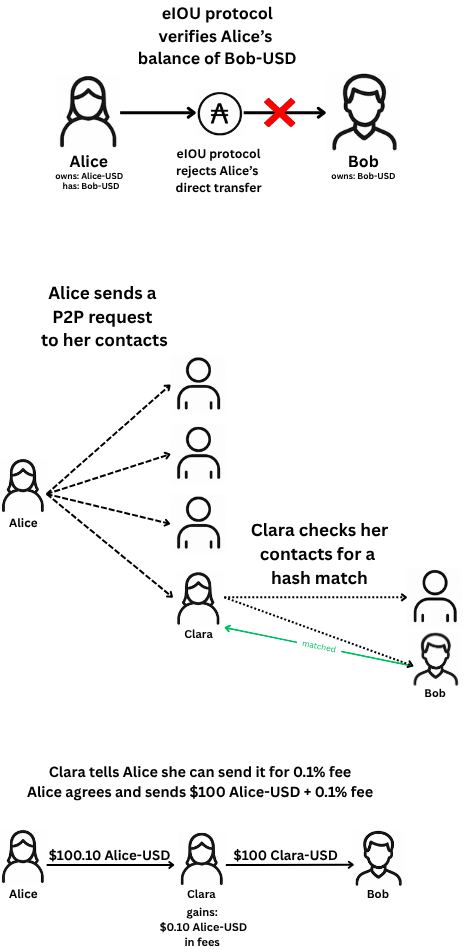
- Alice requests a transfer of $100 Bob-USD tokens to Bob
- Bob rejects Alice's transfer request
-
Alice sends a Peer to Peer request searching for someone who can
send $100 USD to Bob
-
Carla calculates the hash for each of her contacts, checking if any
match the hash Alice sent
-
Carla finds a match, checks her credit with Bob, and informs Alice
he can send it for a 0.1% fee
- Carla's trust is used to guarantee the payment
- Carla receives $100.10 worth of Alice-USD tokens
- Bob receives $100 worth of Carla-USD tokens
Business Use Cases
Supplier Payment Chain
A manufacturer needs to pay multiple suppliers in a chain. Each
supplier can create their own tokens (e.g., SupplierA-USD,
SupplierB-USD).
- Manufacturer initiates payment to final supplier
- eIOU Protocol automatically splits and routes payments
-
Each supplier receives their portion in tokens they are willing to
accept, either that of their trusted partners or their own tokens
- All transactions are settled simultaneously
-
Suppliers can settle with each other, the manufacturer, or customers
through traditional means (bank transfers, trade credit, etc.)
Retail & Online Payments
Point of Sale Integration
A café owner wants to accept eIOU Wallet payments alongside
traditional payment methods. The café creates Café-USD tokens that
customers can hold.
- Payment terminal is integrated with eIOU Wallet
- Customer scans QR code or taps their phone
- Payment is processed instantly through the network
-
Merchant receives funds in tokens they are willing to accept,
including Café-USD tokens
-
Merchant can sell Café-USD tokens, same as they would use gift
cards, and settle with customers through various means (cash, bank
transfer, or keep the credit for future purchases)
Online Store Checkout
An e-commerce platform integrates eIOU Wallet for seamless online
payments. The store creates Store-USD tokens that customers can hold.
-
Customer selects eIOU Protocol at checkout, and pays using eIOU
Wallet
- Payment is routed through the network
- Order is confirmed instantly
-
Merchant receives payment in tokens they accept, including Store-USD
tokens
-
Merchant can sell Store-USD tokens, the same as they would gift
cards, and settle with customers through various means (bank
transfer, store credit, etc.)
Restaurant Payment System
A restaurant chain implements eIOU Wallet for table payments and staff
tips. The restaurant creates Restaurant-USD tokens, and staff can
create their own Staff-USD tokens.
- Customers can split bills automatically
-
Tips are distributed instantly to staff in tokens they accept,
including Staff-USD tokens
-
Payments are settled in real-time in tokens they accept, including
Restaurant-USD tokens
- No need for cash handling or card processing fees
-
Staff can settle with the restaurant through various means (bank
transfer, cash, etc.)
Supermarket Checkout
A supermarket chain adopts eIOU Protocol for faster checkout
experiences. The supermarket creates Market-USD tokens that customers
can hold.
- Self-checkout terminals accept eIOU Wallet payments
- Customers can pay with their phones
- Loyalty points are automatically credited
- Receipts are stored digitally
-
Customers can settle with the supermarket through various means
(bank transfer, store credit, etc.)
Settlement Options
Flexible Settlement Methods
When it's time to settle debts in the eIOU network, users have
multiple options to transfer value back through the network.
-
Bank transfers can be used to settle debts with any connected user
-
Cash payments can be made in person and recorded in the network
- Goods and services can be exchanged to settle debts
- Work or labor can be provided to settle outstanding balances
-
Users can choose how to maintain the credit relationship for future
transactions
Business Settlement Example
A supplier and manufacturer can settle their eIOU tokens through
various business arrangements.
- Traditional bank transfers or wire payments
- Trade credit for future orders
- Exchange of goods or services
- Extended payment terms with interest
- Combination of multiple settlement methods
Real-world Credit Example
Let's use a simple example of lending a hammer to understand how
credit and debt work in the network:
-
Alice lends Bob her hammer (Alice creates Alice-Hammer tokens)
-
Bob then lends the hammer to Carol (Bob creates Bob-Hammer tokens)
-
If Carol doesn't return the hammer to Bob, Bob still owes Alice a
hammer
-
This demonstrates how credit relationships are maintained
independently in the network
-
Each person is responsible for their own credit relationships,
regardless of what happens downstream